Showing posts with label Year 13 Film Studies. Show all posts

Friday, 5 October 2012

Year 13 Film Studies - Practical Coursework

What do you have to do?

(i) aims and context

A clarification of the aims and context of the product to be completed on the appropriate cover sheet.

Please note: the 'Aims and Context' must be completed on the appropriate cover sheet, otherwise the Creative Project and accompanying Reflective Analysis cannot be adequately assessed.

(ii) creative product (45 marks)

A complete short film (3-5 minutes in length).

Group work is permitted for this option (maximum 3) but members of the group must be responsible for a clearly defined role on which they are assessed.

(iii) reflective analysis - approximately 1000 words or equivalent

(15 marks, including aims and context)

The reflective analysis should select key features of the creative product and reflect critically on both the creative process and the product. Candidates working in a group should focus on the construction and impact of their role.
How will you be marked?


Product

• Product fulfils its aims highly creatively and effectively

• An excellent understanding of the form and conventions of the chosen medium

• An excellent, highly creative and confident use of the relevant medium with a strong sense of reaching its intended audience.

Quality of written communication (where relevant)

• Excellently structured and accurate use of appropriate language to communicate clearly.

Reflective analysis

• A detailed and perceptive account of the creative process and production

• Excellent, perceptive consideration of the relative success of the product in relation to its aims, audience and context

• An excellent sense of how far it has been possible to work creatively within the conventions of the chosen product’s medium.

Quality of (written) communication

• Excellently structured and accurate use of appropriate language to communicate clearly.


What is the short film format?

Are short films important?

Examples of Short Film

In order to have a better idea of what is possible for your own project it is a good idea to watch examples of the form.
You should also construct an informed opinion about these films.
Do they work? Are they good? Do they tell a good story? Do they tell it well? Is the sound effective? Are the visuals striking? Are the performances engaging? Is it a genre film? Is it enjoyable?

Still Life - http://www.youtube.com/watch?v=La6T8Bq6CsU

Bubbling Under - http://vimeo.com/24232786

The Room at the Top of the Stairs

There’s a Lot of ‘em About

Luvstruck Run Free - http://www.youtube.com/watch?v=uyx_xa3Us_M

Dead End - http://www.youtube.com/watch?v=yq-ykmGAa1k

The Halloween Kid

Erica Wexler is Online

A Heap of Trouble - http://www.youtube.com/watch?v=nE_wbO45FYE

The Sandman - http://www.youtube.com/watch?v=UjgHbRrnjhU

The Process

1.  Idea Generation

2. Building the Idea

3.  Writing a logline

4.  Story Beats

5.  Writing a synopsis

6.  Writing the script

7.  Re-writing the script

8.  Writing a Shot List

9.  Planning the shoot

10.  Shooting the film

Thursday, 26 April 2012

Fight Club - Student-Taught Lessons

The following presentations are the resources and lesson plans created entirely by Year 13 students (2012).  They contain some excellent insight and information.  They are very valuable revision resources - please use them!

Themes in Fight Club
Theme in Fight Club

Critical Response
Fight Club - Critical Reception

Critical Theories
Fight Club - Critical Theories

The Significance of Marla Singer
Fight Club - Marla


Anti-Capitalism in Fight Club

Thursday, 5 April 2012

Surrealism


Surrealist and Fantasy Cinema

Make reference to The Phantom of Liberty and/or Alice.  You must refer to a minimum of three appropriate films in total.

1.    1.   “Surreal sequences often distance the spectators rather than involve them.”  Has this been your experience in studying films for this topic?

2.     2.  Write an introduction to a season of films made up of those you have studied for this topic, which draws attention to some of the ways in which these films offer a different kind of cinematic experience from the kind of Hollywood fantasy film available at the local multiplex.

3.     3.  What are some of the most interesting ways in which films you have studied challenge our usual experience of watching narrative realist cinema?

4.     4.  Some filmmakers use the medium of cinema in more exciting ways than others.”  How far have you found this to be true in your viewing of films for this topic?

5.     5.  How far do you believe the films you have studied for this topic were motivated by their filmmaker’s commitment to distinctive social and/or political values?

6.     6.  How important is it to see the films you have studied for this topic as being marked by their specific time and place of production?

Wednesday, 7 March 2012

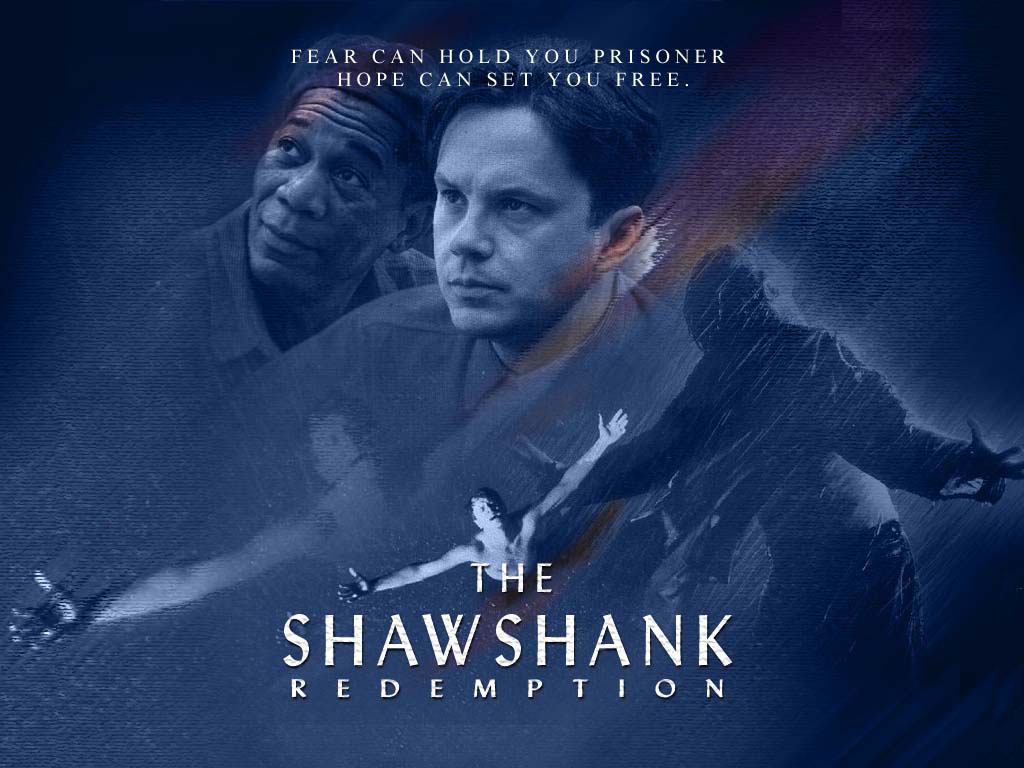
The Shawshank Redemption - Key Text Notes

The Shawshank Redemption
(Frank Darabont 1994)

Film Information
Directed by:  Frank Darabont
CAST
Andy Dufresne:  Tim Robbins
Ellis Boyd "Red" Redding:  Morgan Freeman
Warden Norton:  Bob Gunton
Captain Hadley:  Clancy Brown
Heywood:  William Sadler
Tommy:  Gil Bellows
Brooks:  James Whitmore
Boggs:  Mark Rolston

SYNOPSIS

After the murder of his wife, hotshot banker Andrew Dufresne is sent to Shawshank Prison, where the usual unpleasantness occurs. Over the years, he retains hope and eventually gains the respect of his fellow inmates, especially longtime convict "Red" Redding, a black marketeer, and becomes influential within the prison
Preferred Reading
The emotions the film aims to provoke in the spectator are very closely linked to the themes which drive the narrative:  Hope, injustice, friendship, fear, imprisonment and freedom, retribution.

Of all the emotions the spectator is manipulated to experience within the film as a whole the most prominent are:

Triumph - When Andy wins small victories such as on the rooftop or when he plays the music, the spectator is positioned to feel a sense of triumph.  When he finally escapes, that sense of triumph is magnified enormously.

Despair - There is much sadness within the film; Brooks' lonely death, Andy's wrongful imprisonment, the loss of hope in Red.

Satisfaction - There is so much injustice in the film that when justice is served or characters get some measure of revenge or retribution we feel it very strongly.  The warden being forced to kill himself is an excellent example.

Pity - The spectator is manipulated to feel great sympathy and pity for the characters.  The prisoners go through terrible experiences and have many of their human rights and dignities stripped from them.  Due to immersion, identification and representation we feel sorry for them.

Joy - The joy of Red and Andy's reunion as free men is the arguably one of the most affecting moments in the film.  It is certainly the most joyful.  There are other moments of joy too - the music scene and the rooftop scene as well as Andy's escape.

Injustice - Huge injustices take place in the film and the protagonists are almost constantly being abused, exploited or brutalised.  The serial sexual attacks on Andy, the prison guards' brutality, the violence, the murder of Tommy, the rejection of parole.

Macro-features - Narrative and Genre
The film belongs to the prison drama genre and its narrative is in line with its genre.  It tells the story of a wrongfully imprisoned man who undergoes a huge amount of brutal abuse, injustice and hardship yet manages to retain his sense of hope and ultimately escape to freedom and bring his corrupt captors to justice.

This narrative is inherently emotionally provocative as it taps into some very basic emotions and instinctive feelings - freedom, injustice, revenge.

The fact that it has a 'happy ending' is also relevant, especially when looked at in terms of its overall narrative structure.  The vast majority of the film is about the abuses and degradation Andy and his friends suffer as inmate os Shawshank Prison.  Although they win a few petty victories - the library, the beers on the roof etc, their life is one of misery and degradation which mounts and mounts.  This constant increasing of despair and hopelessness manipulates the spectator to feel enormous elation when the put upon hero is finally liberated and vindicated.

Representation
The representations of the characters and places within the film are an important part of how this film works to position the spectator to feel emotion.

The warden and guards are consistently represented as being corrupt, sadistic and completely unlikable.  This is exemplified in Warden Norton and Captain Hadley.  Norton is hypocritical, power-hungry, greedy, corrupt, selfish and ultimately murderous.  Hadley is similarly corrupt but is also violent, sadistic, hateful and foul-mouthed.  He wields his power even over the other guards.  The way they look, act, speak and are spoken to all reflect this very clearly.  They both dress meticulously and claim to have higher morals than others but are in fact criminals themselves.  Norton and Hadley are very clearly the 'villains' of the film.  There are a few more sympathetic guards seen but these are generally very sidelined and usually completely dominated by either Hadley or Norton.

The prisoners are, in contrast to this, very scruffy and worn.  They are represented in a very un-dangerous way.  They may be prisoners who have all committed terrible crimes but their representations make the spectator like them and feel sympathy for them.  They are likeable, kind (even to small animals), generous, and sympathetic.  The spectator is encouraged to identify with them.

The prison itself is represented as an incredibly bleak, grey and oppressive place.  Its thick stone walls are present in nearly every scene and gates and bars can be seen in every direction.  The lighting is often dark and oppressive inside and grey and bleak on the outside.

Spectator Alignment (Identification)
The spectator is constantly encouraged to sympathise and identify with Andy and Red. A large part of how this is done is through voice over.  The voice over is a technique which means that characters speak directly to the spectator thus putting them in the speaker's viewpoint much more firmly.  Everything we see in the film is through Red's eyes.  He tells us how to feel and how to think about many of the key moments in the film.

Close Analysis - Key Scene 1 - The Mozart Scene

Scene Summary:  The prison receives a large delivery of books and records due to Andy's persistent letter-writing.  Andy takes advantage of  the opportunity when he is briefly left alone by one of the softer  prison guards and locks himself in the warden's office.  He uses the tannoy system to broadcast a piece of classical music by Mozart to the entire prison.  Although he is punished severely for his actions all the inmates felt free for a fleeting moment of beauty.

Preferred reading:  The emotions of awed beauty, joy, happiness and triumph when Andy plays the music as well as fear of the reprisal he will face as a result.

Techniques Used to Provoke Emotion

Narrative structure:  The scene immediately before this one is one of the saddest moments in the film - Brooks' death.  We hear Brooks voice as he reads a letter he has written to Andy and Red accompanied by images of his life outside the prison and subsequent death by his own hand.  It is a pitiful, lonely and heart-breaking scene which leaves the spectator feeling very sad and 'down'.  This scene of rebellion and triumph gives the spectator an emotional tone shift and moment of relief.  The satisfaction and elation felt in this scene is keener due to the despair felt in the previous scene.

Cinematography/ Imagery:  Slow camera movements are used to great effect here as the prisoners stop what they are doing and look up at the speaker in awed silence and reverence.  The slow panning out of the camera as it looks down on the prison yard is especially effective as it shows the scale of the stunt and how even the wardens are shocked into silence and inactivity as a result of it.

Sound: The sound of the music itself gets louder throughout the scene and takes the place of nearly all over sound.  This encourages us to feel what the prisoners feel as they listen to the moving and beautiful music.  A voice over is again employed to anchor the meaning and add to it.

Performance:  Morgan Freeman's rich and sonorous tones add a huge amount of gravitas and feeling to the voice over dialogue.

Voice Over:  As with much of the film, this sequence use a voice over which aligns the spectator with Red's point of view.

Dialogue: "I have no idea to this day what those two Italian ladies were singing about. Truth is, I don't wanna know. Some things are best left unsaid. I'd like to think they were singing about something so beautiful it can't be expressed in words, and it makes your heart ache because of it. I tell you those voices soared, higher and farther than anybody in a grey place dares to dream. It was like some beautiful bird flapped into our drab little cage and made these walls dissolve away, and for the briefest of moments, every last man in Shawshank felt free."

Oppositional Reading:  Morgan Freeman's voice has become very distinctive since (and partly because of) this film.  Voice overs using his voice are particularly well known and it is almost a cliche for when a film wants to impart dramatic or emotional content.  This could cause a spectator to view the scene as overly-manipulative or too 'schmaltzy' or 'cheesy'.

Close Analysis - Key Scene 2


Scene Summary:  Andy returns to his cell after performing his usual routine having been released from solitary confinement after the incident with Tommy.  Red (and the audience) are very worried that Andy will kill himself in his cell that night.  In the morning, Andy has disappeared and it is revealed to the audience that he escaped in the night.

Preferred reading:  The intention of the scene is to make the spectator feel tension and anxiety which then turns to confusion and intrigue and finally turning to outright triumph, joy and satisfaction as the scene builds to its conclusion.

Techniques Used to Provoke Emotion

Narrative structure:  In the overall narrative of the film this scene occurs almost at the end.  Much of the film has shown the abuses and degradations suffered by Andy and the other prisoners with an escalating sense of severity and injustice.  This triumphant scene is made all the more satisfying as a result of this.  The scene itself is structured so that we worry that Andy has committed suicide as a result of all the terrible things that have happened to him.  Our sense of relief that this 'worst case scenario' has not happened increases our joy when we see that he has actually escaped.

Cinematography/ Imagery:  The tight, cramped shots of Andy in the sewer pipe covered in filth and excrement give a very apt visual metaphor for the abuses he has suffered and the journey he has ben forced to take.  The final shot of the scene of Andy, finally free - shirtless, washed clean by the rain in the dramatic lighting of the thunder storm is a powerful image and as the camera rises into an aerial shot and Andy looks up at the sky with his arms spread in an almost Christ-like pose the power is heightened.

Sound: The music effectively guides the spectator's emotions as it swells in an orchestral and moving piece of music.  Earlier in the scene, sound is used very effectively to give the impression of mystery as the warden throws a stone at the poster.  The stone rips through the poster and 'plinks' into the darkness beyond.  This is our first understanding of what has happened.

Performance:  The scene is anchored by Tim Robbins' immersive performance of Andy Dufresne.  Morgan freeman's voice performance is also a powerful emotive factor.

Voice Over:  Another Morgan Freeman voice over  - again it encourages the spectator to identify or align themselves with the character and the 'side' they are on. 

Thursday, 23 February 2012

Spectatorship - Popular Film and Emotional Response


EXAM TOPIC


Spectatorship - Popular Film and Emotional Response


In Film Studies, the exploration of people's responses to film is termed 'spectatorship'.


Spectatorship is about studying spectators and exploring how and why people respond to films as they do.  It involves exploring:


The impact of the film viewing experience - the environment.
The impact on people of the way films are constructed - their micro and macro features.
The degree to which all spectators respond in the same way.

What is Emotion?


"A mental state that arises spontaneously rather than through conscious effort and is often accompanied by physiological changes; a feeling: the emotions of joy, sorrow, reverence, hate and love.”

How is Emotion Provoked?


Popular films manipulate their audience's emotions in order to provide pleasure.  This unit is concerned with examining how this is done.


Narrative and themes. 
Characters.
Imagery.
Sound.
Dialogue.
Performance.
Cinematography.


These could all be summarised as:


MANIPULATION
IDENTIFICATION
IMMERSION


Emotional Involvement and Identification  


We are encouraged to IDENTIFY with characters; to become emotionally involved with them, to feel as they do. 


This process of identification is sometimes called Alignment and refers to the way spectators are encouraged to relate to characters' emotions as well as to adopt their point of view.  


The emotional impact of a film frequently depends on spectator alignment with central characters.


Preferred Reading

The degree to which all spectators respond in the same way.

Do all spectators respond the same way?

Does gender make a difference? Class, race, religion?

The response that a director intends to create is the 'preferred reading' but this is not always what the spectator experiences.

Sample Questions


1.     1.  Explore possible reasons to explain why a second or third viewing of a film can actually increase the emotional response rather than lessen it.

2.      2.  How far is emotional response to mainstream films triggered by specific techniques used by the filmmakers?

3.      3.  From your experience, is it true to say that the emotional impact of some films comes from their subject matter whilst for other films the impact is created through the use of cinematic devices?

4.      4.  From your studies, discuss what you have found to be some of the most interesting ways in which filmmakers produce an emotional effect on the spectator.  Make detailed reference to specific films in your answer. 

5.      5.  “It is when film spectators are being shocked that they are most aware that they are being manipulated.”  Has this been your experience? Make detailed reference to film extracts you have studied in developing your answer.

6.      6.  ‘One of the greatest pleasures of popular cinema is surrendering to the film experience and allowing ourselves to be emotionally manipulated.’ Discuss this statement with reference to the films you have studied for this topic.

7.      7.  ‘Emotional response to a popular film is dependent on the ways in which we are made to identify with particular characters.’ How far has this been your experience?


Key Texts
THE SHAWSHANK REDEMPTION
(Frank Darabont 1994)

Please click here for detailed information on this film.


Thursday, 26 January 2012

Theme in Fight Club

Themes of Fight Club

Wednesday, 25 January 2012

Year 13 Film Studies - Current Lesson and Homework Information


Thursday 19/4/12

Topic of lesson:  Fight Club Revision
Areas covered: Creative revision exercise - preparing a lesson to deliver next week.

Homework: Write a detailed lesson plan/presentation script to hand in after your lesson next week.
Due in:  Thursday 26/4/12

Thursday 5/4/12

Topic of lesson:  Wider knowledge.  
Areas covered: Screening of The Social Network
Homework: Choose one of the emotional response questions on the blog and answer it.


Due in:  Thursday 19/4/12


Thursday 29/3/12

Topic of lesson:  Creative revision
Areas covered: How emotions are created in your own text.

Homework: Write an analysis of how you provoked emotion in the film sequence you planned out in class.


Due in:  Thursday 


Thursday 22/3/12

Topic of lesson:  Analysis of key text -  Insidious (James Wan 2011)

Areas covered:  Emotions provoked in the film, use of sound, imagery, alignment, representation, narrative structure, key scene analysis.

Homework:  Write a detailed close analysis of the scene you looked at in class.  Include all correct terminology and make reference to specific textual examples using the micro-elements. 

Typed 600 words minimum.

Due in:  Thursday 29/3/12

Thursday 15/3/12

Topic of lesson:  Key text screening - Insidious (James Wan 2011)

Areas covered:  Film screened.

Homework:  The film, Insidious (James Wan 2011) attempts to provoke the emotions of fear, shock, suspense and sympathy in the spectator.  Referring to detailed textual examples and narrative structure and theme, representation of characters and use of sound and imagery discuss how successful it is at doing this. 

Typed 1000 words minimum.

Due in:  Thursday 22/3/12


Thursday 8/3/12

Topic of lesson:  Analysis of manipulation of emotions in The Shawshank Redemption (Frank Darabont 1994)

Areas covered:  Exploration into what the main emotions created in the film are and how this is done.  Key scene analysis, personal response, preferred and oppositional readings.

Homework:  Write a close analysis of the escape scene in The Shawshank Redemption.  Explain what emotions are provoked and how with reference to both macro and micro elements and using correct terminology.  700 words.  Typed

Due in:  Thursday 15/3/12

Thursday 1/3/12

Topic of lesson:  SCREENING - The Shawshank Redemption (Frank Darabont 1994)

Areas covered:  Key text viewed.

Homework:  Write an account of what emotions the film is trying to provoke and how it does this.  500-700 words.  Typed

Due in:  Thursday 8/3/12


Thursday 23/2/12

Topic of lesson:  Spectatorship:  Popular film and emotional response - intro.

Areas covered:  Emotions, how they are provoked and manipulated, immersion, manipulation and identification.

Homework:  Choose a scene from a film that you find particularly emotional and write an account (500 words- typed) of what emotions it provokes and how.  Use the specific terminology. 

Due in:  Thursday 1/3/12


Thursday 2/2/12

Topic of lesson:  Schuchardt's theory of Fight Club.

Areas covered:  Detailed explanation of the Schuchardt article and how it applies to the text.

Homework:  Revise Fight Club theories, themes, context and key sequences for mock exam next lesson.

Due in:  Thursday 9/2/12


Thursday 25/1/12

Topic of lesson:  Key scene analysis.

Areas covered:  Recap of John McCullogh's theory in Tedium and Torture, recap of themes of Fight Club, Analysis of 3 key scenes.

Homework:  Write an analysis of the second key scene in Fight Club and how it illustrates the film's themes as well as how it relates to McCullogh's interpretation of the film.

Due in:  Thursday 2/2/12